
Projected and Actual Bertie Release Dates
A projected release date is an administrative forecast for an active sentence. It draws on the judgment, sentence structure, credit, and rules that apply to that person. It does not prove that the person walked out. The actual release date is the historical field that confirms an incarceration episode ended. Even then, read the release status and destination. A person may leave prison for post-release supervision, parole, another agency's hold, or a transfer rather than becoming free of all legal control.
Bertie County records can involve more than one agency. The Bertie–Martin Regional Jail holds local pretrial and short-term cases, while the North Carolina Department of Adult Correction manages state sentences. A county booking end and an NCDAC discharge are separate events. Match the name, birth information when lawfully available, booking or offender number, and the exact custody episode before relying on any date.
Find a Bertie Projected Release Date
Start with the legal custodian, not merely the building where the person sleeps. The distinction is vital in Bertie County because local detainees were relocated to state facilities after the June 2026 disruption. Physical placement at Bertie Correctional Institution or the North Carolina Correctional Institution for Women does not turn a pretrial county detainee into an NCDAC-sentenced prisoner. The committing court and regional jail still control the local case and release record unless an agency confirms otherwise.
- Identify the full name, approximate admission date, case number, booking number, or NCDAC offender number. Use the durable offender number when one is known.
- For a state sentence, open the NCDAC Offender Public Information search. Match the person carefully, then read status, incarceration, sentence, release, and supervision sections together.
- For a Bertie local case, call the Bertie–Martin Regional Jail at 252-794-9283. Ask whether the person is pretrial, serving a local sentence, transferred, or released.
- Check the North Carolina eCourts path for the Bertie County case. A judgment, bond change, or release order may explain the next event, though it may not record the exact departure time.
- Near the forecast date, check the authoritative record again. The full Bertie County released inmate search path helps reconcile jail, court, state, and federal custody.
A missing name is not a release date. Search filters, spelling, sealed matters, data delay, and transfers can all remove a person from one view. Seek an affirmative record or agency response. Record the date of each search because a forecast and custody status can change between checks.
NCDAC Bertie Release Date Fields
The NCDAC record has distinct summary, incarceration, sentence, and supervision areas. A result can show an inmate status and a separate probation, parole, or post-release status. Sentence history may contain several judgments, so one projected date should not be read apart from the sentence number and service status. The strongest reading joins identity, current location, sentence dates, and the actual or projected field that applies to the same term.
Useful detail labels include Admission Date, Admitting Location, Control Status, Current Location, Previous Location, Sentence Number, Commitment Type, Conviction Date, County of Conviction, Sentence Begin Date, Minimum Term, Maximum Term, and Parole Begin and End Dates. Not every field appears on every record. A Bertie County conviction label also does not prove the person was released from a Bertie facility. It identifies the county connected to that judgment, while the location and incarceration history identify the correction path.
The NCDAC Offender Public Information search preserves state correction history beyond a person's departure. It is not a Bertie–Martin recent county-jail feed. The official search screen appears below.
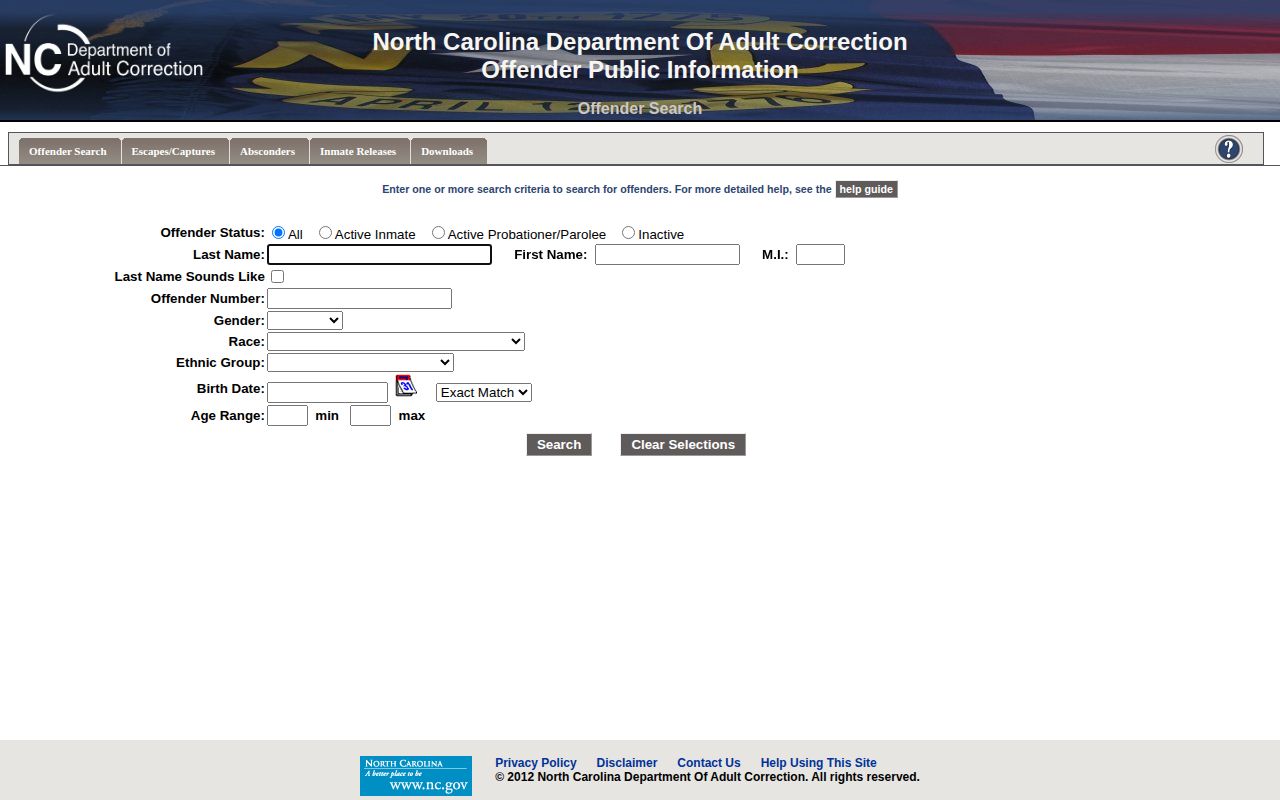
The name and offender-number paths begin the identity match, while a local jail release still requires the regional-jail or court channel.
| Official field | What it establishes |
|---|---|
| Projected Release Date | A forecast tied to an active sentence calculation; it may change. |
| Actual Release Date | The recorded end date for that prison sentence episode. |
| Inmate Status | Whether the correction record reflects active or past prison custody. |
| Supervision Status | Whether probation, parole, or post-release control follows confinement. |
| Current and Previous Location | Placement history, which must not be confused with community release. |
Bertie Pretrial Release Has No Forecast
A pretrial detainee has not received a prison sentence to compute. Bond, a release order, dismissal, plea, trial, a new hold, or another court act controls what happens next. The live jail record answers present custody, while the Bertie court file documents judicial acts. Neither should be forced into the idea of a fixed projected prison date.
Ask the regional jail a precise three-part question: is the person still held, released to the community, or transferred to another custodian? If released, request the effective date, time, and disposition. If transferred, request the receiving agency. During the 2026 relocation, also ask which agency owns the booking and release entry. A detainee housed at an NCDAC prison building can remain under the local commitment, with no NCDAC sentence forecast at all.
Note: A court release order can precede physical departure while staff verify identity, paperwork, and any other valid hold.
Structured Sentencing Sets Release Floors
For North Carolina felonies committed on or after October 1, 1994, Structured Sentencing generally gives the court a minimum and a maximum term. The precise official rule matters. Under G.S. 15A-1340.13(d), the person serves the minimum term, with court-awarded jail credit counted. Earned time can reduce the maximum toward the minimum, but not below that minimum. G.S. 15A-1340.17 supplies sentencing ranges and maximum-term rules, including time associated with post-release supervision.
The common claim that every North Carolina prisoner simply serves 85 percent is wrong. NCDAC describes Structured Sentencing as service of 100 percent of the minimum and at least 85 percent of the maximum. That relationship is not a one-step release calculator. Offense class, prior-record level, the chosen range, jail credit, sentence date, post-release terms, and other judgments still control. Older Fair Sentencing cases, parole-eligible terms, misdemeanors, impaired-driving sentences, life terms, and special statutes may follow other rules.
Post-release supervision is built into the maximum-term framework for covered cases. It follows imprisonment and is not the same as parole. Parole is a discretionary conditional release that remains relevant mainly to eligible older-law and special cases. A projected confinement end can therefore lead into supervision rather than a complete discharge from NCDAC authority. The public record should be read for both parts.
- Minimum term
- The judicial floor for ordinary Structured Sentencing imprisonment, after lawful jail credit.
- Maximum term
- The upper term used in sentence administration and post-release calculations.
- Earned time
- Credit tied to qualifying work or full-time program assignments under NCDAC rules.
- Post-release supervision
- State oversight after prison for covered cases; release from the building is not full discharge.
Earned Time Moves Bertie Projections
NCDAC explains that a Structured Sentencing prisoner may earn time through a work or full-time program assignment. A transfer, discipline, or completion of that assignment can change credit accrual and move the projected release date. Good-time loss under an older Fair Sentencing judgment can also affect its calculation. These rules concern state sentences, not a universal credit automatically granted by Bertie–Martin.
For a local misdemeanor sentence, G.S. 15A-1340.20(d) permits earned-time credits under the rules of the prison or local custodian, with combined credit capped at four days per month. That is a ceiling, not a promise. No Bertie–Martin earned-time policy was found in the research. Ask the jail how the exact local judgment and any awarded credit are being applied.
Note: The sentence law and agency record control; a rough percentage cannot establish a Bertie County actual release date.
What Moves Bertie Release Dates
A forecast can change without error. Sentence administration is ongoing, and a later legal event can alter the inputs. A hold may leave the sentence end date intact yet prevent departure to the community. The current status and destination remain as important as the date.
| Change | Effect on the release path |
|---|---|
| Jail credit correction | The court adds, removes, or corrects credit against the term. |
| Sentence structure | Concurrent or consecutive terms, or another judgment, change the controlling calculation. |
| Work or program status | Earned-time accrual may change when an assignment starts, ends, or changes. |
| Discipline | Credit may be lost, and lawful restoration can move the forecast again. |
| Court action | An appeal, amended judgment, resentencing, or vacated term changes the legal basis. |
| Another agency's hold | Community departure may not occur even when one sentence or custody episode ends. |
Parole is not guaranteed by service of a percentage. Ordinary parole ended for offenses committed under Structured Sentencing, though the Commission retains authority over eligible older-law and special cases. A parole decision and a projected prison date answer different questions.
A detainer is a request or legal basis for another agency to take or keep custody. It may not alter NCDAC's sentence-completion calculation, yet it can change where the person goes next. Likewise, a transfer changes location, not freedom. When the forecast is close, ask whether another judgment, warrant, or receiving agency affects community departure, and request only information the agency may lawfully disclose.
Confirm a Bertie Actual Release
Check OPI again near the forecast. Read the actual release field, inmate status, and supervision status together. If the data seems inconsistent, ask NCDAC to confirm the public record with the offender number. For a local booking, the regional jail and Bertie Clerk are the better custodians. The Clerk can confirm the judgment or release order, while the jail can confirm the actual departure or transfer entry.
North Carolina SAVAN and VINELink can send a custody-event notice, but a notification may lag or describe release from only one agency. The Bertie VINE inmate check explains the specific-person alert path. Verify the result with NCDAC or the local custodian, especially when a detainer, transfer, or supervision term may follow.
When documentary proof is needed, state exactly which entry is sought. For NCDAC, give the offender number and ask for the actual release date, sentence computation, transfer entry, or supervision record. For Bertie–Martin, request the booking and release entry plus any receiving agency. A narrow request helps the custodian identify the right episode and explain any protected part without obscuring the public facts.